


California Contractor License Glossary
Plain definitions of the terms you will see on the CSLB application, in your exam study guides and in California contract law.
Quick answer
California licensing uses a lot of its own vocabulary. The terms below are the ones applicants ask us about most, with links to the guides that explain each one in detail.
Licensing Terms
- CSLB: the Contractors State License Board, the state agency that licenses and regulates contractors in California.
- Classification: the type of work a license allows, such as A General Engineering, B General Building, B-2 Residential Remodeling or a C specialty.
- C-61 Limited Specialty and D categories: specialty work that fits no other C classification is licensed under the C-61, in one of its D categories. C-61 applicants take only the Law and Business exam.
- Qualifying individual (qualifier): the person whose experience and exams qualify the license. It can be the owner, a partner, an officer or an employee.
- RMO and RME: a Responsible Managing Officer is an officer of a corporation or LLC who qualifies the license. A Responsible Managing Employee is a permanent employee who qualifies it. Compare RMO and RME.
- Personnel of record: the owners, officers, partners and qualifiers listed on a license. Changes must be reported to CSLB within 90 days.
- Journey level: fully qualified to do the trade without supervision. CSLB requires four years at this level or higher within the last ten years.
- Inactive license: a renewed license that cannot be used to bid or contract. No bond or workers’ compensation proof is needed while inactive.
- Reciprocity: an agreement that can waive the trade exam for contractors licensed in certain other states. Reciprocity guide.
- Minor work exemption: jobs under $1,000 in combined labor and materials, with no building permit and no employees, do not require a license.
Application and Exam Terms
- Application Fee Number and PIN: the numbers CSLB mails after receiving your application. You use them to check your status online.
- Certification of Work Experience: form 13A-11, where you describe your experience and someone with firsthand knowledge certifies it.
- Live Scan: electronic fingerprinting. You pay $32 for the DOJ check, $17 for the FBI check and the site’s rolling fee.
- Notice to Schedule: the letter that lets you schedule your exams with PSI, the company that gives CSLB exams.
- Law and Business exam: the business and law exam every qualifier takes. Trade exam: the exam for your classification.
- Asbestos open book exam: a short open book exam every new applicant completes before a license is issued.
- Waiver: a CSLB decision that lets an applicant skip an exam in specific situations. Waivers and exemptions.
Bonds, Insurance and Business Terms
- Contractor bond: the $25,000 bond every active license needs. Bond requirements.
- Bond of Qualifying Individual: a second $25,000 bond for licenses qualified by an RME, or by an RMO who owns less than 10 percent of the company.
- LLC Employee/Worker Bond: a $100,000 bond required of limited liability companies.
- Workers’ compensation exemption: a form contractors with no employees can file instead of proof of coverage. C-8, C-20, C-22, C-39 and C-49 contractors cannot use it.
- Commercial general liability (CGL): liability insurance for property damage and injuries. Home improvement contracts must disclose whether you carry it.
- Sole owner: a business owned by one person with no separate legal entity. The initial license fee is $200, compared with $350 for other entities.
Contract and Payment Terms
- Home improvement contract: a contract to improve a home when the price is over $500. It must be in writing and include specific notices. Requirements.
- Down payment: on a home improvement contract it may not exceed $1,000 or 10 percent of the contract price, whichever is less.
- Progress payment: a payment during the job. It may not exceed the value of work done or materials delivered.
- Change order: a written, signed change to the scope or price of a contract. It must be signed before the extra work starts.
- Mechanics lien: a claim against a property by someone who helped improve it and was not paid. Contracts must include a mechanics lien warning.
- Right to cancel: most home improvement buyers can cancel within three business days, five for buyers 65 or older, and seven for disaster repair contracts.
- Home improvement salesperson (HIS): a person registered with CSLB to sell home improvement contracts for a licensed contractor.
- Prevailing wage: the minimum wage rates the state sets for public works projects.
Content reviewed against CSLB sources: November 2026
- CSLB: 2026 California Contractors License Law and Reference Book (PDF)
- CSLB: Bond information
- CSLB: Workers’ compensation requirements
- CSLB: Examination application steps
Online California Contractor License Courses
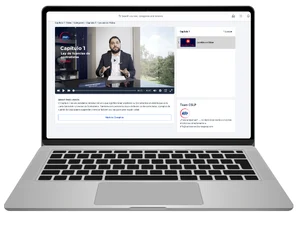
Prepare for your California CSLB Law & Business and Trade exams with flexible online contractor license courses designed for real working contractors. Choose from three study plans with 24/7 online access, bilingual support, weekly live classes, and expert guidance throughout the licensing process.
Fast Track
$595
- 2026 Updated Classes
- Online Law Book
- Online Trade Book
- Weekly Live Online Classes
- Application processing
- 24/7 Online Access
Plus
$1,395
- Everything in “Fast Track”
- Plus:
- Law & Business Flash Cards
- Per Chapter Practice Exams
- Extended Study Time
- Physical Law & Trade Books

Premium
$1,595
- Everything in “Plus”
- Plus:
- Business Launch Checklist
- Digital Business Card ($200 value)
- Double Study Time vs. “Plus”
All Online Course Packages Include:
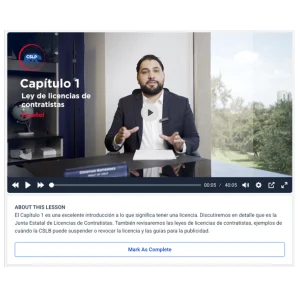 Bilingual Lessons
English & Español
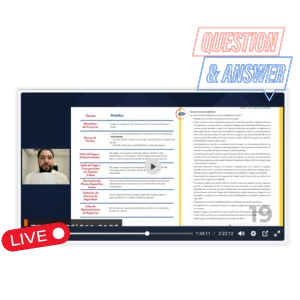 Weekly Live Classes
Online Only
 Law & Trade Books
English & Español
 Proven Results
20,000+ Graduates
California Contractor License Glossary: FAQs
What is the difference between a contractor bond and insurance?
A contractor bond protects consumers and workers if you violate license law or fail to pay. Insurance, such as workers’ compensation or general liability, covers injuries and damage. Every active license needs the bond. Insurance requirements depend on your business.
What does qualifier mean on a contractor license?
The qualifier is the person whose experience and exam results support the license. A company license must have a qualifier, such as an RMO or RME, who is responsible for supervising its construction work.